

Witnessing Transformation Through Holistic Yoga
By Shelley Pagitt
You know those moments in your practice where you find that your body and breath are harmonizing, you are moving with more and more ease, finding yourself lost in the flow…even in stillness? When the mind settles into the background and the thoughts and worries and to-do lists pause long enough to give your whole person space to simply BE HERE NOW? These are the moments that bring me back to my mat, day after day.

As a yoga teacher, this inner-flow is palpable, pushing through the boundaries skin and bones, infusing the studio and students with the essence of silent harmony. I can sense when folks are present to themselves, when they allow themselves to surrender to the safe container of collective community, and when they are tending to their own body, mind, heart, and energy, nourishing the seeds of wholeness. This inner-work is quiet, and subtle, and gentle. It needs no words, no problem-solving, no therapist. As the nervous system down-shifts, intuitive wisdom ignites, untangling roots of stories that bind, and limit, and harm, creating new pathways that offer freedom and ease. It is an honor to hold space for folks as they step out of their busy lives and into the studio, onto their mats. It is an honor to guide breath and movement, but also to guide them to their own inner wisdom. To hold a space that quietly whispers “ALL of you is welcome here.” Because in yoga, our whole self is invited - it’s the weaving, the reworking, the encompassing of ALL of us. When we are on our mats, we don’t need to leave anything behind.
As a holistic yoga teacher, this space we create, this space we hold, is powerful. And although most often it is simply a felt sense or a quiet knowing, every once in a while a student invites us into the courageous work of sifting through the soil of their psyche, gifting us the privilege to witness more. One such student in our holistic yoga teacher training (HYTT) program this past year offered me this gift:
"There was a time, I think, as a young child that I felt whole and unhindered, where I felt connected to myself and at ease in my body. This changed suddenly, it seems, the first time my body was overtaken; when it was forced, disregarded, and hurt. And physical chaos raged in my body, and my mind became filled with chatter that never, ever slowed. I tried, in those early years, to make space for my pain, but my voice was not heard. So I became quiet, and I held my breath. I left my body, detached from my soul, and silenced my inner knowing. And the chaos and the chatter grew and grew until it became utterly intolerable and I broke.
Five years later at the age of 15, I was diagnosed with anorexia. Food restriction and an obsession with thinness had come in as a shield, protecting me from the chaos and the pain I was holding in my body. The smaller I became and the less I ate, the quieter the chaos would become, overshadowed by overwhelming thoughts of food, weight, calories, and thinness. I was broken and empty."

We live in a culture, and truthfully it seems from ancient texts it has always been this way, where the default is to see ourselves as broken, separate, in need of saving. And then when conscious and unconscious harm comes into our lives, the body responds and creates more division and separation, solidifying these patterns of thinking for very good reasons. Religious systems, educational systems, political systems, medical systems, marketing, advertising, and sometimes even yoga, use this narrative to promote whatever they are selling. The truth is, though, that WE ARE WHOLE. And I believe whole-heartedly that our students need to hear - and to experience - this truth as much as we do as teachers. In our wholeness, we have the capacity to hold the parts of ourselves that we don’t like, the parts that harm us, the parts that need work and love and honest attention… all while embodying the truth of our wholeness, goodness, and light.
For Emily, this space that was held for her each time she arrived on her mat, was empowering. After having practiced yoga in a more fitness-focused arena, experiencing holistic yoga brought a shift:
”I’ve been given safe invitations, again and again, to go inside, to listen. The assurances of safety - a holding of me and my practice when I felt myself “going away” - have allowed me to stay. The space is watched, healing touch is offered, permission is given. And the utter reassurances over and over and over again that I hold wisdom, that MY BODY knows what it needs in order to heal, is beginning to take root. My teachers have held a light and have led me to find the teacher inside of me, inside my body. And after hearing it day after day for the past year, I have finally embraced the mantra “There is nothing to prove, and nothing to hide.”
The concept of “holism” took root for me in college, when studying child development, and is the lens that I choose, as best as I am able, to witness myself and others. It is clear that as humans develop, one of the first things we do is learn to distinguish one thing from another, and to assign language to every different thing we experience - every color, every object, every emotion, every person, every place, etc. As we grow, the different places, things and people are subconsciously assigned to categories of ‘good’ and ‘bad’, based on our comfort and discomfort, our preferences and familiarity with whatever we are encountering. This is all ‘normal’ child development and supports the need for each person to develop a strong sense of self, a self that has agency and ability to function in a very complex world.

And then at some point it is essential that we begin to see ourselves as connected to the broader swath of humanity. That the things that make me uniquely me, are different than you, and the ways in which we, are different from them, settle in to the background muzak, while the more interesting harmony of human diversity begins to play at the foreground. And, it seems, that if we are not able or willing to see ourselves as part of the whole of humanity the divisions increase establishing patterns of seeing and being root in tribalism, life becomes more insular, ‘our way’ becomes ‘the way’, and leads to deeply engrained dualistic thinking.
And this brings us back to holistic yoga. The word yoga means, “union”, from the word “yug”, meaning “to yoke”. I think of it as holistic integration - the whole person, all of our thoughts, words, actions, beliefs, past, present - all together, connected to others, and to the divine. The wholly practice of yoga - including mantra, mudra, asana, meditation, breath, stillness… is an invitation to unification, within and around.
The power of Hatha (“Ha” - sun, “tha” - moon) Yoga is a practical practice supporting our attempt to reconcile to unify, the very irreconcilable dualities within us, ie, “How can I be generous and super loving in one moment and petty and jealous the next?” If we are honest with ourselves we can see that we are greedy and not greedy, we are self-righteous and we are humble, we are truthful and we manipulate the truth, we are jealous and generous, we are caring and we cause harm. Living with awareness of these dualities is not for the faint of heart. It often leads us to think that we are broken, fractured, where the “good” parts are welcome and the “bad” parts are banished, deepening the inner and outer divisions.
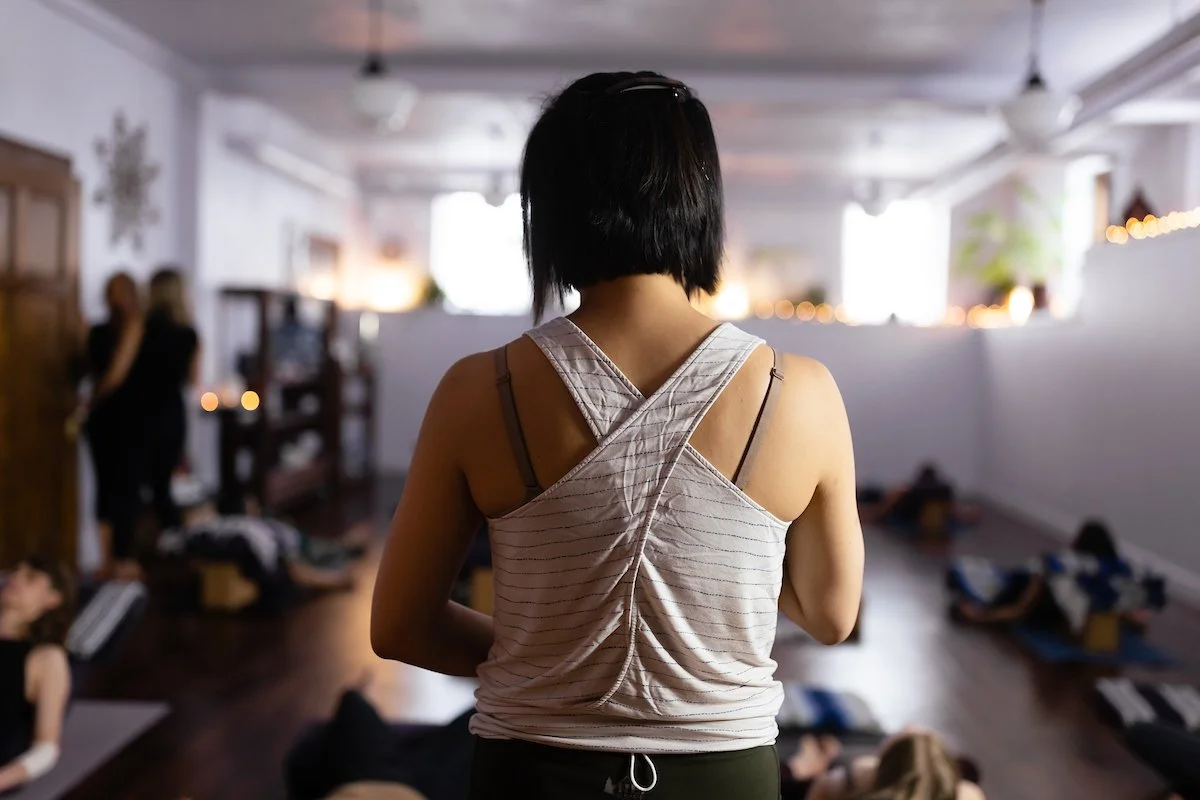
Yoga, as a living practice rooted in breath, invites us to take the posture of compassionate witness where we can look honestly at ourselves, cringing at times, but keeping our eyes and heart open as a welcoming presence. When I am rooted in this practice, I am able to see each student as whole, remembering that I am not ‘healing’ anyone, but gifted with the privilege of witnessing transformation, sensing inner harmony as the inner divides soften through collective, outer flow.
Bearing witness to Emily’s journey gives me hope for humanity.